Guruvayupura Pancharatnam
Showing posts with label krishna. Show all posts
Showing posts with label krishna. Show all posts
Tuesday, January 28, 2020

Wednesday, December 4, 2019
Narayaneeyam by Narayana Bhattadri Dasakam 100
Narayaneeyam- Dasakam 100


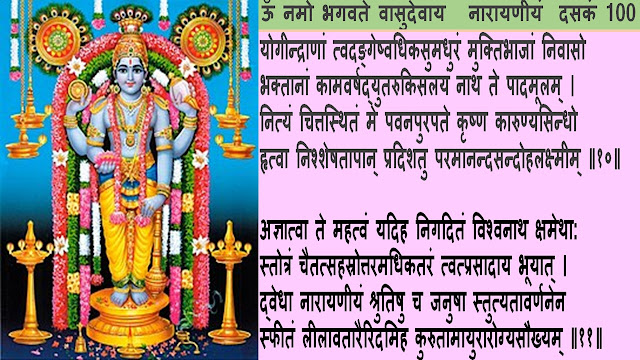
Sri Narayana Bhattadri, a sanskrit scholar suffered from incurable disease. He gets advice from a Kerala astrolger to go to and sing the glory of Lord Guruvayurappanan at Guruvayoor. He sings the glory of ten Avatars of the Lord in 100 Dasakas. Lord Guruvayurappa gives his darshan and cures his disese and Sri Narayana Bhattadri sings the beauty of Lord Gruvayurappan in this 100th Dasakam as seen by him .


Tuesday, August 29, 2017


Friday, December 9, 2016
Gita Jayanthi Mokshada Ekadasi
Gita Jayanthi Mokshada Ekadasi
Mokshada Ekadashi is observed on December 14th, 2021. Lord Krishna explained the significance of this Ekadasi to Yudhistira as narrated in Brahmanda Purana. Observing this Ekadasi helps forefathers to get to heaven, as per the advice of Parvata Muni.
Lord Krishna blessed Bhagavad Gita to Arjuna on Mokshada Ekadasi. It is celebrated as Gita Jayanthi.
In Chapter 10 Lord Krishna narrates a small segment of His Divine Glory ( Vibhuthi) to Arjuna.
Here is a presentation of the same.


Friday, September 4, 2015


Tuesday, December 2, 2014
Sri Guruvaupuresa Suprabatha Stavah
Sri Guruvaupuresa Suprabatha Stavah
Mokshada Ekadasi is observed in Guruvayur Teme on 2nd December. Kesavan the temple elephant that served Sri Guruvayurappn for 54 years and died on Mokshada Ekadas day is honored today.On a similar this Ekadasi day 5000 years ago, that Lord Krishna preached the Bhagavad Gita to Arjuna
Let us dwell on Sri Guruvaupuresa Suprabatha Stavah


Friday, August 22, 2014
Lotus Feet of Lord Krishna
Lotus Feet of Lord Krishna
18.66 सर्व-धर्मान्-परित्यज्य मामेकं शरणं व्रज
अहं त्वां सर्वपापेभ्यो मोक्श्ययिष्यामि मा शुचः
Lord Krishna emphasizes on "Maamekam Saranam Vraja". The Moolavar deities in many temples have their left hand pointing to His Lotus feet. In Some temples the Moolavar has these words Inscribed on their left palm.
I came across this Krishna Padambhujam Slokam on Lord Guruvayurappa. The moment I think of Lord Krishna , Temples of Lord Venkatkrishnan at Triplicane and Sri Guruvayurappan at Guruvayur comes to my memory. I offer this rendering to them
As this Sloka One should surrender to the Lotus feet of Lord Krishna which
- Is Auspicious and Beautiful
- Confers auspiciousness
- Removes of all Problems
- Confers Happiness
- Destroys wicked
- Liked by devoted
- Grants Liberation
- Bestows Strength
- Truth and Divinity personified
- Removes bad effects of karma
- Is not comparable
- Is Ever pure
- Bestows joy
- Destroys evil minded
- Confers bliss and happiness
- Cuts off ties
Let us surrender and pray this Holy Lotus feet daily, sing its glory daily and remember daily


Thursday, August 21, 2014
Sri Krishna Dwadasa Nama Stothram 12 Holy Names of Lord Krishna
Sri Krishna Dwadasa Nama Stothram
12 Holy Names of Lord Krishna
In this Stothram, Lord Krishna reveals to Arjuna, the 12 holy names attached to him. Whoever Chants this stotram On Amavasya, Pournami or Dwadasi would get the merits of giving a Kanya in marriage, performing one thousand Chandrayanas, performing one thousand Aswamedha Yagam

Tuesday, July 15, 2014
Sri Guruvayupureesa Mangala Stuti
Sri Guruvayupureesa Mangala Stuti
If Lord Rama gave Ishvaku kula deity Lord Ranganatha to Vibheeshana which later Stayed at Srirangam facing south giving darshaan to Ilangai, Lord Krishna offered his family deity which later got installed at Guruvayoor with the help of Guru and Vayu Bhagawan. This Temple is known by the name of Guruvayurappan who is swayam Lord Krishna himself.
Guruvayurappan has given darshan to Narayan Bhattadri the composer of Narayaneeyam and enacted many of his leelas as Bala Krishna and helped him to compose Narayaneeyam. Finally Guruvayurappan gives Vishwa rupa darshanam which Narayana Bhattadri details in the 100th dasakam of Narayaneeyam as Kesadhipada Varnam.
Presented below is the Guruvayupreesa Mangala Stuti.
In this sloka Lord Guruvayurappan is addressed as
- Krishna
- Mukunda
- Jagadeesa
- Hrishikesa
- Vasudeva( son of Nandagopa)
- Nanda Putra
- DevaDeva
- Consort of Dauaghter of Ocean, Mahalakshmi
Sri Guruvauurappan is also described as
- Ruler of the entire Universe
- Endowed with Tender heart with lots of compassion
- Endowed with Kingly and Divine greatness
- on whose chest shines Goddess Lakshmi
- Giving strength to control all senses
- radiating like glowing Sun
- Destroyer of all Sufferings
- Helping devotees to cross the ocean of Samsara


Tuesday, July 1, 2014
Lord Krishna in the role of Madhava
Lord Krishna in the role of Madhava
Lord Madhava is also another name for Vishnu or Krishna. There are Three occurrences of Madhava in Vishnu Sahasranama. Madhava means spouse of Mahalakshmi.

Lord krishna was addressed as Madhava By Arjuna Krishna-Arjuan Sambhashan in Bhagavad Gita. Lord Krishna has Radha Mdhava temple in Kerala.
I came across this Madhav Stuthi at http://stotraratna.sathyasaibababrotherhood.org/v80.htm. I believe the author is Kadathanattu .K.Padmanabha variar. and Translated by. P.R.Ramachander.
Liked the lyrics. Mostly Glorifies Lord Krishna in the role of Madhava. I did not see any audio recordings on google. I tried to render to the Tune of Haraivarasanam. If any one comes across a professional rendering please let me know.


Saturday, May 31, 2014
Madhava Panchakam composed by Oothukkakdu Venkat Kavi
Madhava Panchakam
composed by Oothukkakdu Venkat Kavi
Oothukkakdu Venkat Kavi has composed a set of five verses
dedicated to a Lord Madhava, a form of Lord Vishnu.
These verses are set to a meter of five units (khanda gati),
These verses are known as Madhava Panchakam.
dedicated to a Lord Madhava, a form of Lord Vishnu.
These verses are set to a meter of five units (khanda gati),
These verses are known as Madhava Panchakam.
Venkata Kavi offers his prayers to Lord Madhava, and advises us
to meditate the Rupa of Madhava constantly.


to meditate the Rupa of Madhava constantly.
Subscribe to:
Posts (Atom)